Preventive Maintenance for Restaurants: Schedule First
Concoct team
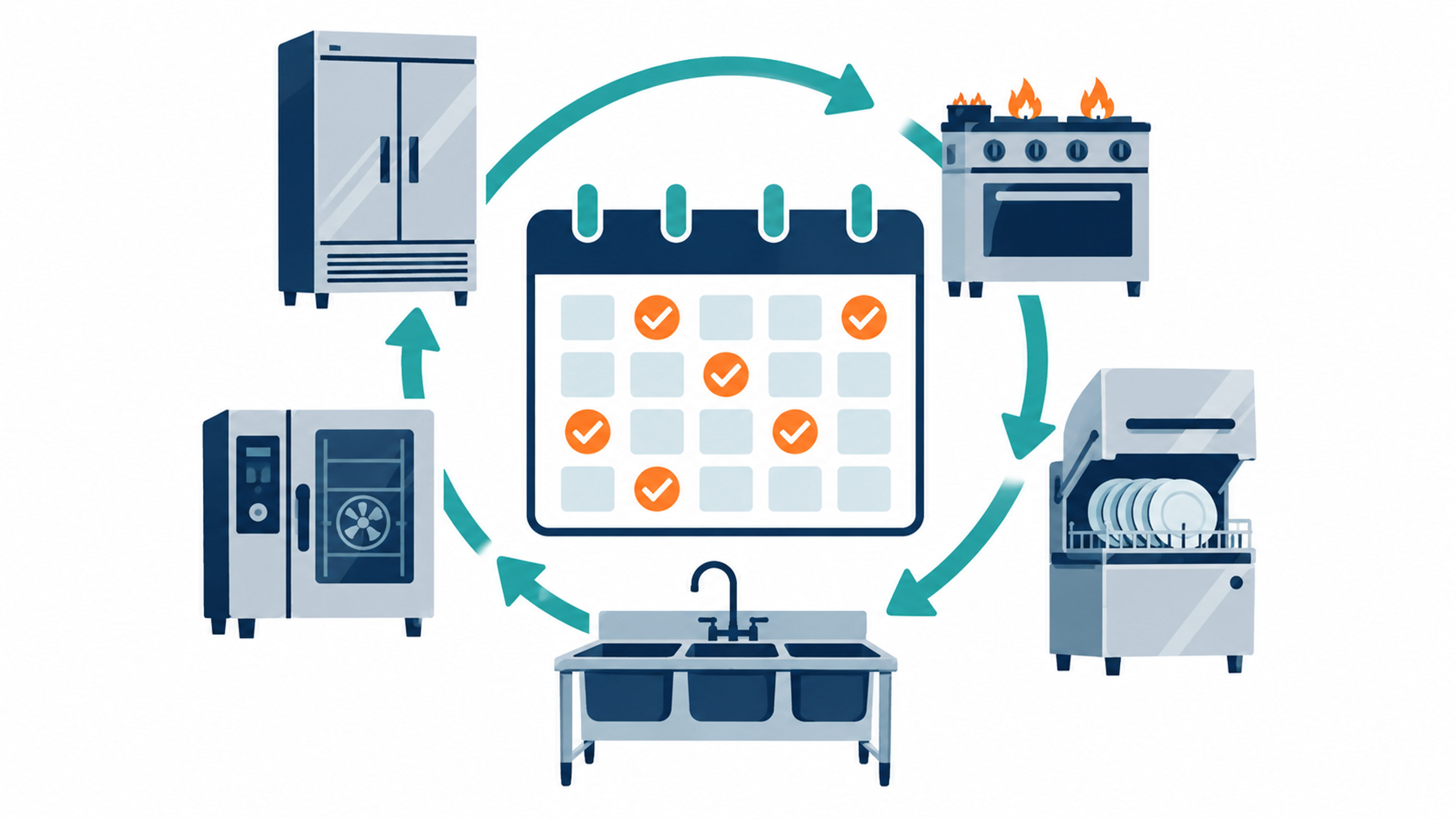
Picture a Saturday at 6:40 p.m. The walk-in reads 9°C, the dinner rush starts in twenty minutes, and the manager is shuffling chicken into a reach-in that is already full. The compressor had been loud for two weeks. Nobody scheduled anything, because nobody had a short list of preventive maintenance restaurants should do first.
This guide ranks work by two things: what it costs when the equipment fails, and what warning you usually get beforehand. It is general guidance. Intervals depend on your equipment, your volume and your local rules, so check with the manufacturer, your insurer and your local authority before you fix them.
How to decide what goes first
Ask three questions about each piece of equipment.
- What does it cost when it fails mid-service? Count lost sales, spoiled product and the emergency call-out premium.
- Does it warn you first? Noise, heat, ice, slow drainage and weak airflow are cheap early signals. Equipment that fails silently needs a fixed schedule, because nothing will tip you off.
- Is the prevention cheap? Cleaning a condenser coil is a short job. Replacing a compressor is not.
High cost and cheap prevention goes to the top.
Preventive maintenance for restaurants: the first five
1. Walk-in and reach-in refrigeration
Failure cost is the highest in the building. Product loss, possibly pausing food service, and a weekend repair call all land at once.
Warning signs: a louder or constantly running compressor, ice on the evaporator or door frame, warm spots, a torn door gasket, water pooling under the unit.
Schedule: coil cleaning on a regular cycle (commonly cited as quarterly, sooner in greasy or dusty kitchens; confirm with the manufacturer). Check gaskets and door closure monthly. Log temperatures daily.
2. Ice machines
A failed ice machine hurts a QSR or convenience store quickly, and a dirty one is a food-safety problem as well as a repair problem.
Warning signs: slow or cloudy ice, odd taste, slime in the bin, long cycle times, water on the floor.
Schedule: cleaning and sanitising on the manufacturer's cycle, plus water filter changes on schedule. Local water quality affects the interval, so ask your service company.
3. Hood exhaust and grease systems
Here the cost is a fire, not a repair bill. It is also the one most likely to be set by your insurer or fire authority.
Warning signs: grease dripping from the hood, smoke not clearing, heavy residue on filters, a grease trap that smells or backs up.
Schedule: hood and duct cleaning and grease trap pumping at whatever frequency your insurer, local authority and cooking volume require. Do not guess this one. Ask them, then put the dates on a calendar more than one person can see.
4. HVAC and rooftop units
Rooftop units rarely fail on a quiet day. They fail on the hottest or coldest day of the year, when every contractor in town is booked.
Warning signs: uneven temperatures between rooms, a unit that runs constantly, rising energy bills, ice on lines, unusual noises at startup.
Schedule: filter checks monthly in dusty or grease-heavy sites, and a contractor inspection before the cooling season and before the heating season.
5. Fryers and the cooking line
Fryers fail in small ways first, and each one costs speed and oil.
Warning signs: slow recovery after loading, oil breaking down faster, temperature swings, a pilot that will not hold.
Schedule: oil filtration and boil-outs on the manufacturer's cycle, and a technician check of thermostats and safety controls as the manual states.
Then add these
Once the five are scheduled and actually happening, add:
- Water heaters: flushing, plus a look at the anode and relief valve. Rusty water, popping noises and slow recovery are the warnings.
- Drains and floor sinks: cleaning before they back up. A slow drain is the warning.
- Dish machines: delime and check wash and rinse temperatures. A film on glasses is the warning.
For convenience stores, add beverage dispensing, display coolers and lot lighting. The restaurant and convenience store maintenance checklist lists daily, weekly and quarterly items by equipment type.
What makes a schedule stick
Most plans fail for ordinary reasons, not technical ones.
- One owner per task. "The kitchen" does not own the coil cleaning. A named person does.
- A due date and a record of completion. A task nobody closes out is a task nobody did.
- A work order for every exception. If the compressor is loud, that is a job with a site, a piece of equipment and a priority, not a text message.
- Equipment history in one place. Make, model, serial number and install date help the contractor arrive with the right part, and the last repair note is the most useful thing you have the second time.
- A rollout you can sustain. Run five jobs at every site for a quarter before adding more. The 30-day rollout plan for 10 sites shows one way to sequence it.
You can do all of this in a spreadsheet and a shared calendar, and many operators do. The usual breaking point is several sites and several contractors, when nobody can see what is overdue without asking three people.
Where Concoct fits
Concoct is priced per location with unlimited users. Recurring schedules are on every tier, including Starter: you attach a schedule to a piece of equipment, pick the frequency, and work orders are created as they come due. Store managers can log a problem as a request. An owner, operations manager or dispatcher assigns the job to a contractor, who gets one emailed link for that job and needs no account.
What it does not do: it will not tell you the right interval for your equipment, it does not replace a licensed contractor or your insurer's requirements, and it has no offline mode. If a vendor does not respond within 24 hours, the job is unassigned and you are alerted to reassign it by hand.
Next step
To see what per-location pricing looks like at your site count, the pricing page lists every tier. If you would rather see schedules and work orders on your own equipment list, book a demo and bring your five highest-risk items.
FAQ
What is preventive maintenance for a restaurant?
It is scheduled work done on equipment before it breaks: cleaning coils, changing filters, checking seals and temperatures, and having specialists inspect hoods, HVAC and gas equipment. The aim is to catch small problems on your schedule rather than during service.
What should a restaurant schedule first?
Start with the equipment whose failure costs the most and gives the cheapest warning: refrigeration, ice machines, hood and grease systems, rooftop HVAC and fryers. Add water heaters, drains and dish machines once those five are running reliably.
How often should I service restaurant equipment?
It depends on the equipment, volume and conditions. Follow the manufacturer's manual first, then your insurer's and local authority's requirements for hoods, grease and fire safety. The intervals here are starting points to confirm, not rules.
Do I need software for preventive maintenance?
No. A spreadsheet and a shared calendar work for a single site. Software starts to help when you have several locations and contractors and need to see overdue work and equipment history without asking around.
Can Concoct schedule recurring preventive maintenance?
Yes. Recurring schedules are included on every tier and create work orders when tasks come due. Concoct does not set the interval for you, so take that from the manufacturer, your insurer and your service company.